
Guides · Checklist & example
How to plan annual bills in your monthly budget
A €600 bill arrives once a year. Your monthly plan can account for it in advance with a regular €50 share. You also need to know when the full €600 payment is due.
Annual amount ÷ 12 gives the regular monthly share. Check the next due date and any money already set aside as well. A monthly average alone does not tell you whether the next bill is covered.
1. Collect the bills that belong in your plan
Check your contracts, invoice emails and previous statements for recurring bills. Include payments made every two, three or six months. Write down the amount per payment, its interval and the next confirmed due date.
- Insurance premiums billed annually or twice a year
- Club fees and other recurring memberships
- Software, storage or media subscriptions billed annually
- Regular fees with an interval of several months
Include only costs that apply to you. An unexpected repair is not a known annual bill; allow a separate buffer in your own plan for uncertain costs.
2. Calculate the monthly share
Divide each payment by the number of months in its recurring interval: twelve for annual bills, six for twice-yearly bills and three for quarterly bills. The amounts below are illustrative examples.
| Bill | Amount per payment | Interval | Monthly share |
|---|---|---|---|
| Car insurance | €600 | Yearly | €50 |
| Contents insurance | €120 | Yearly | €10 |
| Membership fee | €90 | Quarterly | €30 |
| Total | €1,080 per year | €90 |
Together, these three bills have a €90 monthly planning share. Enter your own amounts and intervals in the sinking fund calculator.
Calculate now: Sinking fund calculator3. Check the first due date separately
Suppose the €600 bill is due in two months and you have not set anything aside. Two €50 contributions give you only €100, leaving a €500 gap. The ongoing monthly share and preparing for this first payment are separate tasks.
Write down how much you already have reserved and which contributions you can actually make before the deadline. With no existing savings and two equal contributions, this example would require €300 each. After the payment, the share for the next full annual cycle returns to €50 a month.
Kalvo’s monthly reserve share is a planning figure. The app does not track a savings account balance or calculate a personal catch-up contribution before the first due date.
4. Separate the monthly share from the actual payment
The full €600 is due in the payment month. The €50 is a share spread across the year, not an additional invoice from the insurer. Do not count both figures as separate payments for the same bill.
Enter €600, a yearly interval and the confirmed next due date in the bill calendar. It shows the actual payment month alongside monthly bills. Check dates against your documents; a calculated calendar does not confirm that a payment has happened.
Calculate now: Bill calendar5. Bring the bills into Kalvo
Calculate your list in the sinking fund calculator and add the next due date for the CSV download. The file contains original bill amounts and intervals: the annual bill stays €600, rather than becoming a new €50 monthly bill.
- Download the CSV file from the tool on your iPhone and save it in Files.
- Open Kalvo → More → Export & Import → Import transactions, then select the file. Review the preview and confirm the import.
- Check each title, amount, interval, currency and first due date after importing.
- Open Reserves to see the monthly share. Choose the payment month in Overview.
- If useful, enable local reminders in Settings and allow Kalvo notifications.
Import is available within the free limits. Import each bill once; importing the same file again may create additional entries. Use the same currency as your Kalvo setting.
6. Update the plan when your contract changes
When a premium changes, update its amount and due date. Before the new year, check which bills will continue. Keep a separate record of actual savings and transfers wherever you manage your money.
Kalvo shows recurring costs and dates. Local reminders arrive before a due date; actual payments remain with you or your payment provider.
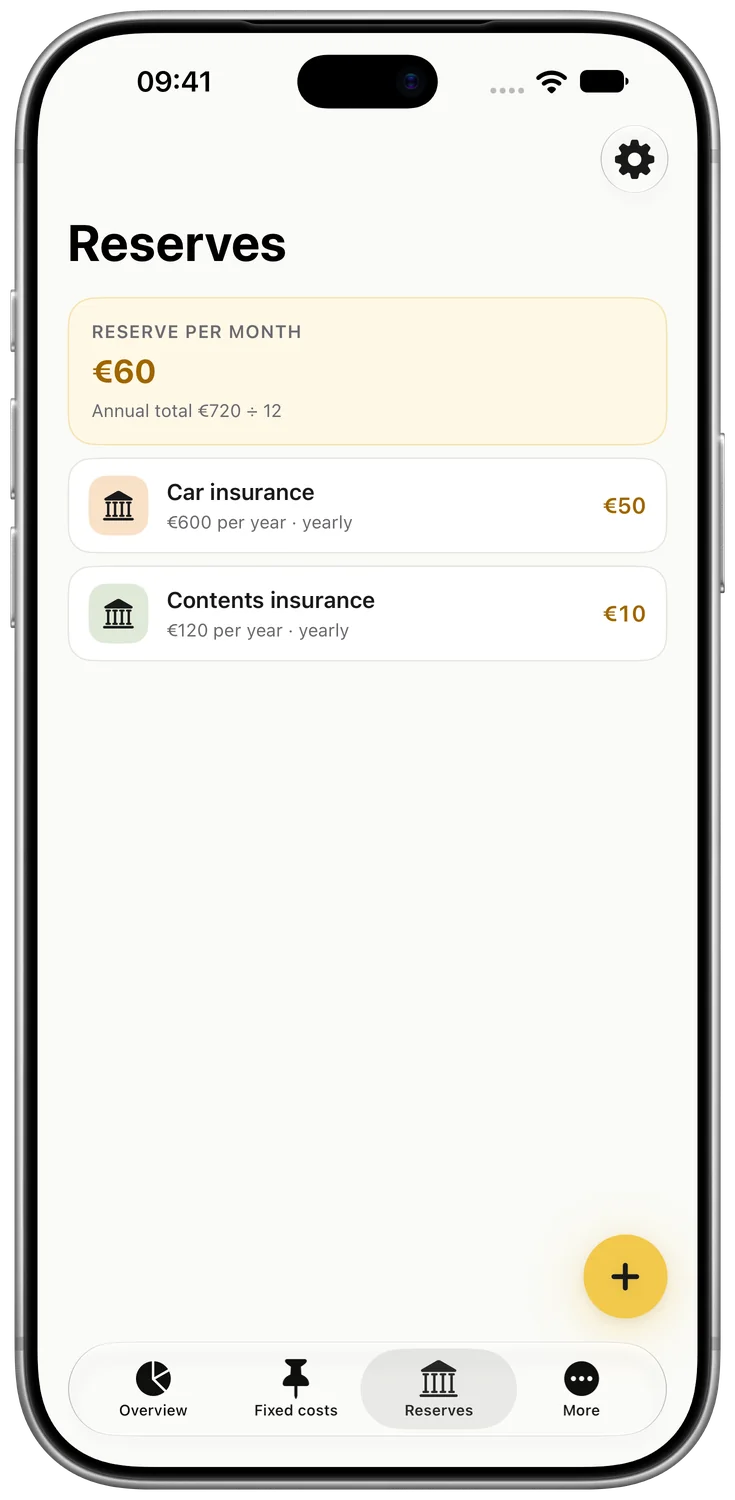
Your plan on iPhone
Keep your plan in Kalvo
Import recurring bills from the tools as a CSV file and keep track of their next due dates on your iPhone.
Get Kalvo freeFor iPhone with iOS 26 or later. 10 active recurring bills and 2 reserves free. Pro is an optional one-time purchase.
Frequently asked questions
How much should I plan monthly for an annual bill?
For a complete annual cycle, divide the known annual amount by twelve. A €600 bill has a €50 monthly share. Check a nearby first due date separately using existing savings and the contributions you can still make.
Can I plan quarterly bills the same way?
Yes. Divide each quarterly payment by three. A €90 quarterly bill has a €30 monthly share and costs €360 a year.
Does Kalvo move money into savings automatically?
No. Kalvo calculates the planning share and organises due dates. It does not access your bank account or make transfers.